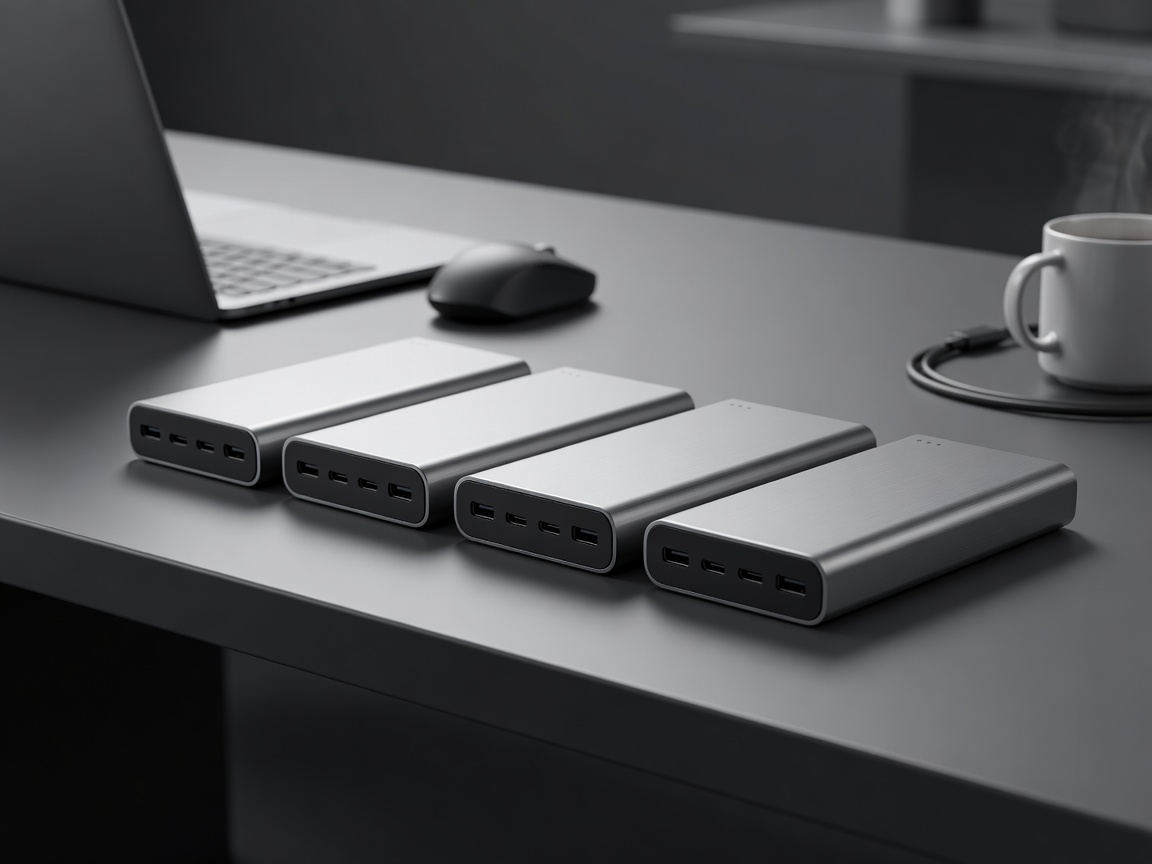
Keeping devices powered while navigating layovers, remote locations, and full-day excursions is a foundational challenge of modern travel. A depleted smartphone means losing access to digital boarding passes, mapping applications, translation tools, and emergency contacts. The portable charger market has evolved significantly, shifting from bulky, slow-charging lithium-ion bricks to sophisticated units leveraging Power Delivery (PD) and advanced circuitry.
Understanding Capacity vs. Portability
The core metric of any power bank is its capacity, measured in milliampere-hours (mAh). However, a higher capacity inherently means more physical weight and volume. Travellers must strike a balance based on their specific needs.
The 10,000mAh Sweet Spot
For most urban travellers, a 10,000mAh unit represents the ideal compromise. These chargers typically weigh around 200–250 grams and fit easily in a pocket or daypack. A power bank in this class can reliably recharge a modern smartphone two to three times, which is generally sufficient to survive a heavy day of GPS usage and photography without returning to a wall outlet.
The 20,000mAh to 27,000mAh Heavyweights
Digital nomads and professionals carrying laptops or tablets often require substantially more juice. Units ranging from 20,000mAh up to roughly 27,000mAh are built for this purpose. While they can weigh over 500 grams, they possess the capacity to fully recharge an ultrabook or keep a smartphone running for nearly a week.
Airline Regulations and the 100Wh Limit
When selecting a high-capacity power bank, international aviation regulations are a crucial factor. The International Civil Aviation Organization (ICAO) and aviation authorities like the FAA and EASA stipulate that lithium-ion batteries carried in the cabin must not exceed 100 watt-hours (Wh) without specific airline approval. (Batteries between 101Wh and 160Wh may be allowed with airline permission, but anything over 160Wh is strictly prohibited on passenger aircraft).
To calculate Watt-hours from mAh, you multiply the mAh by the battery voltage (typically 3.7V for internal lithium-ion cells) and divide by 1000. Under this formula, the 100Wh limit equates to approximately 27,027mAh. This is why the largest travel-focused power banks strategically cap out at exactly 26,800mAh or 27,000mAh, ensuring friction-free passage through airport security.
Crucial Rule: Power banks must always be packed in carry-on luggage. They are explicitly banned from checked baggage due to the risk of thermal runaway in the cargo hold.
Output Wattage and Power Delivery (PD)
Capacity is only half the equation; how fast the power bank can deliver that energy is equally important. Traditional USB-A ports max out at 12W to 18W, which is painfully slow for modern high-capacity batteries. USB-C Power Delivery (PD) is the current standard, capable of negotiating power levels to deliver exactly what the device needs.
- 20W - 30W Output: Ideal for fast-charging flagship smartphones and tablets.
- 45W - 65W Output: The minimum recommended for charging ultrabooks and lightweight laptops while in use.
- 100W+ Output: Designed for high-performance laptops. Note that running at 100W will deplete a power bank's capacity extremely rapidly.
The Rise of GaN Technology
While Gallium Nitride (GaN) technology is most commonly associated with wall chargers, its benefits are influencing portable battery design as well. GaN is a semiconductor material that produces less heat than traditional silicon. This allows internal components to be placed closer together safely, resulting in more compact circuitry and faster energy transfer. When pairing a power bank with a wall charger to refill the bank itself at night, a high-wattage GaN wall charger is essential to reduce the refill time from 8 hours down to a manageable 2 or 3 hours.
Pros and Cons of Integrated Features
Many power banks now feature integrated cables, wireless charging pads, or even solar panels. While convenient, these come with trade-offs:
- Wireless Charging: Convenient for eliminating cables, but highly inefficient. Wireless charging generates significant heat and can waste up to 30% of the battery’s capacity in transfer loss.
- Integrated Cables: Great for minimalists, but if the integrated cable breaks, the power bank loses a primary function.
- Solar Panels: The surface area of a power bank is simply too small for meaningful solar charging. It can take weeks of direct sunlight to fully charge a 20,000mAh battery via a built-in panel. Treat this feature as an extreme emergency trickle-charge rather than a primary power source.
By understanding your device's power requirements, familiarizing yourself with airline regulations, and prioritizing USB-C PD output, you can ensure you never face a dead battery halfway through a critical travel day.