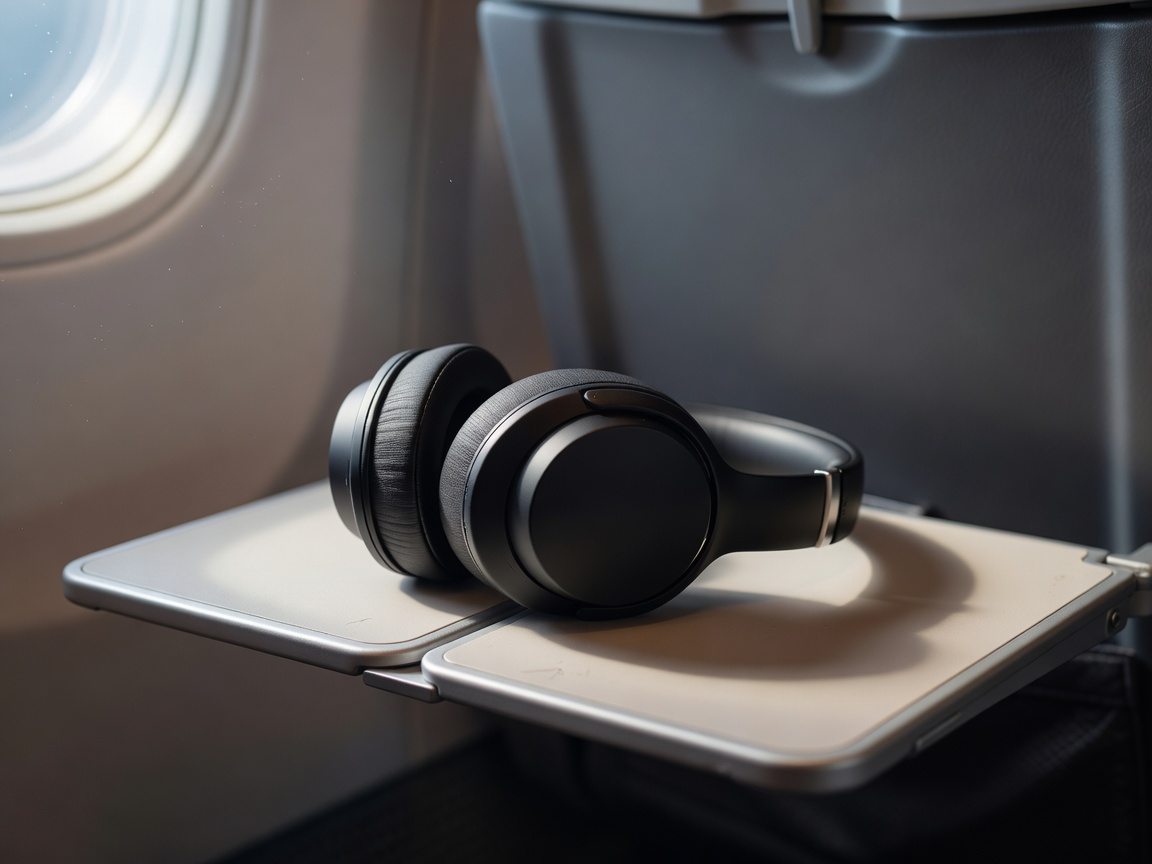
The cabin of a commercial jetliner produces a constant, fatiguing drone hovering around 80 to 85 decibels. Extended exposure to this low-frequency roar increases stress, disrupts sleep, and contributes significantly to travel fatigue. Active Noise Cancellation (ANC) audio equipment is no longer considered a luxury for the frequent flyer; it is an essential piece of health and comfort gear.
How Active Noise Cancellation Works
Passive isolation involves physically blocking sound waves—much like putting your fingers in your ears. Earcups with dense foam and tightly sealing silicone ear tips provide this passive barrier, which is highly effective against high-frequency sounds like crying babies or clattering galley carts.
Active Noise Cancellation tackles the low-frequency sounds that penetrate passive barriers (like engine rumble). Microphones mounted on the outside (feedforward) and inside (feedback) of the headphones listen to ambient noise. Integrated processors then generate a sound wave that is exactly 180 degrees out of phase with the incoming noise. When these opposing waves collide, they cancel each other out—a phenomenon known as destructive interference.
Over-Ear vs. In-Ear: The Traveller's Dilemma
The choice between circumaural (over-ear) headphones and intra-aural (in-ear) true wireless earbuds dictates your travel experience in several distinct ways.
Over-Ear Headphones
- Pros: Superior passive isolation, vast battery life (often 30+ hours), massive drivers for better soundstage, and physical comfort for long-haul flights where nothing is resting inside the ear canal.
- Cons: Highly bulky. Even with folding hinges, they consume significant space in a carry-on. In warm climates or during brisk walks through terminals, they can cause excessive sweating.
True Wireless Earbuds
- Pros: Ultimate portability. The charging case slips into a pocket. They are discreet, often sweat-resistant for workouts at the destination, and can easily be worn while sleeping on a travel pillow.
- Cons: Limited continuous battery life (usually 5-8 hours before needing a top-up in the case). In-ear pressure can cause discomfort over a 12-hour flight. Prone to being dropped or lost under airplane seats.
Transparency Modes and Situational Awareness
While blocking the world out is the primary goal, travel inherently requires moments of acute awareness—listening for gate changes, speaking to flight attendants, or navigating busy streets. Modern ANC devices feature "Transparency" or "Ambient" modes. Instead of generating inverse waves, the exterior microphones amplify external sounds and pipe them directly to the speakers, allowing you to hear perfectly without removing the device. The quality of this feature varies wildly; premium models process this audio instantaneously to sound natural, while cheaper models often introduce a hollow, digitized echo.
Understanding Bluetooth Codecs
Audio quality over Bluetooth is dictated by compression algorithms called codecs. Knowing what your smartphone supports is critical when purchasing headphones, as both devices must support the codec to use it.
- SBC: The universal baseline codec. Reliable, but offers the lowest audio quality.
- AAC: The standard for Apple devices. Excellent efficiency and solid quality, though Android devices handle AAC processing variably.
- aptX & aptX Adaptive: Qualcomm's proprietary codecs standard on many Androids, offering higher bitrates and lower latency (crucial for watching movies on flights without lip-sync issues).
- LDAC: Sony's high-resolution codec capable of transmitting massive amounts of data. Supported by many high-end Android phones, it provides near-CD quality over wireless connections.
Wired Connections on Aircraft
Despite the wireless revolution, many long-haul aircraft still utilize seatback in-flight entertainment (IFE) systems requiring a 3.5mm jack (or a dual-prong airline jack). If IFE is important to you, over-ear headphones that include a physical cable in the case are necessary. A Bluetooth transmitter—a small dongle that plugs into the IFE and broadcasts to your wireless earbuds—is an increasingly popular workaround for earbud users.